You can subscribe to get latest updates on the site through email in the toolbar at the bottom!

Friday, March 30, 2007

Vaisakhi Program - Shri Guru Nanak Darbar Gurdwara Gravesend Kent DA12 1LD UK

WAHO WAHO GOBIND SINGH AAPE GUR CHELA
VAISAKHI PROGRAM
Shri Guru Nanak Darbar Gurdwara Clarence Place Gravesend Kent DA12 1LD
13,14,15th April 2007
Friday 13th April 2007 - 10am - Shri Akandh Path Sahib Arambh
Saturday 14th April 2007 - 11 am - Start of Vaisakhi Nager Kirtan - 12am Nager Kirtan reaches Shri Guru Nanak Education and Sports Complex Khalsa Avenue Gravesend Kent - 4pm Nager Kirtan will arrive outside Shri Guru Nanak Darbar Gravesend Kent
Saturday 14th April 2007 - 7pm - Amrit Sanchar - 5 kakar will be provided anybody who wants to take amrit and become khalsa should arrive at Shri Guru Nanak Darbar Gurdwara Gravesend Kent in the back hall at 7pm with a kesi ishnaan done.
Sunday 15th April 2007 - 10am - Bhog Shri Akhand Path Sahib at Shri Guru Nanak Darbar Gurdwara Gravesend Kent bhog will be followed by diwaan with kirtan,katha,dhadis and lectures.
A humble benti to all sangat to attend evey day and celebrate Vaisakhi 2007.
All sangat is requested to join the nager kirtan on saturday 14th april 2007 at 11pm outiside Shri Guru Nanak Darbar Gurdwara Gravesend Kent with thousands of sikh sangat.
Anyone who wants to take amrit should be at Shri Guru Nanak Darbar Gravesend Kent on Saturday 14th April 2007 at 7pm sharp.

Waho Waho Gur Gobind Singh Ji


One of the main Sikh festivals is Vaisakhi which traditionally was the end of the wheat harvest but became extra special because it was chosen by Guru Gobind Singh as the day to start the Khalsa fellowship.


On April 13th in the gurdwara a special ceremony takes place as a reminder of the first Amrit Ceremony.


The first Amrit Ceremony took place in India in 1699 when Guru Gobind Singh asked a gathering of Sikhs who was prepared to die for God. At first there was a hesitation then one man stepped forward...he was taken into the tent, Guru Gobind Singh reappeared on his own with blood dripping from his sword. He asked again, and again, again and again. He took the fifth man into the tent and then reappeared with all five men, alive, well and dressed like him. These five men became known as Panj Pyares or Beloved Five. They were initiated into the "Khalsa" or community of Sikhs by receiving amrit...a mixture of sugar and water. Sikh men were then given the added name "Singh" meaning "lion" and ladies received the extra name "Kaur" meaning "princess".

The five Sikhs that are performing the ceremony mix the amrit. When the water and sugar has been mixed all of the five Sikhs stir it with a double edged sword while hymns are being sung and readings are read from the Guru Granth Sahib.


New members who wish to become initiated come before the five Sikhs that are performing the ceremony. Amrit is sprinkled on their eyes and hair, finally they drink the mixture. Everyone recites the Mool Mantra and the new members must then wear the five Ks. Prayers are said, speeches made, reading listened to and finally the whole community will share a meal, the langar, with everyone present Sikh and non-Sikh.


Friday, February 02, 2007

Baba Deep Singh - Saint Soldier


Baba Deep Singh was the saint soldier who weilded the holy sword and who called out the real man among the herds of humanity Deepa of Phuvin, a village in the district Amritsar, born as Bhai Bhagatu Ji's son in January 1682 A.D. (14 Marh, Samvant 1739) was the blessed son of Punjab, who became the defender of the national honour.
In a way his entire life had been a preparation for his ultimate martyrdom in 1765. Let us go back to 1699, the Baisakhi, when Shri Guru Gobind Singh Ji gave us a new lease of life. The Khalsa Panth was founded with the holy Guru's invocation to the Singhs among men to step forward and sacrifice their lives, give Seesh in the service of God. The consecrated Amrit infused in the youth the lenging to dedicate themselves to the teaching of Dashmesh Pita, the preceptor and our father divine.
The ensuing Baisakhi witnessed throngs of Sikhs at Anandpur Sahib. Among them was the eighteen year old Deepa, accompanied by his parents. Once again the consecrated water was stirred accompanied by recitation of Gurbani by the Panj Pyaras and Dashmesh Pita, leading the five beloveds as their Jathedar, their leader. Deepa was blessed with this nector divine, the Amrit and intiated into the Khalsa Panth, known as Deep Singh.
The impact of community worship and community meal, partaken with the recitation of the holy hymns, the shabads, was so great that Deep Singh found himself drawn to the holy precints of Anandpur Sahib. With the permission of his parents, he implored Guru Maharaj to give him the privilege of staying there for some time and imbibe the tenets of Sikhism.
Baba Deep Singh was quick in learning Gurmukhi. He tood to the Gurmukhi alphabet instinctively, and before long, he had developed a beautiful hand writing. Bhai Mani Singh initated him into learning to holy scrputure, the Bani and the keen learner, Deep Singh lost no time in learning the hymns, the Bani, by heart.
Equally adept at horse riding and weilding the weapons, Baba Deep Singh distinguished himself in hunting with Satguru Sahib, he shot a lion and credited himself as a brave hunter. Barely 20 or 22 of age, Baba Deep Singh was a scholar and a valient soldier.
Baba Deep Singh was summoned by his parents to his native village for his marriage, with the permission of the Tenth Master, Guru Gobind Singh Ji. Before the marriage could be performed, news was received at their village that Guru Ji had left Anandpur Sahib and his four sons and many Sikhs had fallen as martyrs while fighting against the armires of treacherous Hindu Hill Kings and Mughal rulers.
On hearing about these events, Baba Deep Singh left his home and riding his horse, proceeded in search of his beloved Guru. His earnest search proved fruitful when he found Guru Gobind Singh Ji at village Sabo ki Talwandi (Now Damdama Sahib in the District of Bhatinda). Tears rolling down his eyes, Baba Deep Singh lay at the feet of Guru Ji asking for-giveness for not being present at Anandpur Sahib during the siege. Guru Ji blessed Baba Deep Singh and told him that he was being assigned special duty of preparing copies of Adi Granth Sahib. He was asked to assist Bhai Mani Singh Ji in this literary task of utmost improtance. They would act as preachers of Sikhism while at the sametime, participate in battles to be fought in the defence of the faith.
The reafter Baba Deep Singh remained at village Sabo ki Talwandi (then renamed as Guru Ki Kanshi), for the rest of his life, preparing copies of Adi Granth Sahib and preaching the teaching of Sikh Gurus. These copies of Adi Granth Sahib were prepared and sent to Sikh centres far and wide. After Guru Gobind Singh Ji had left for his heavenly abode, Bhai Mani Singh was assigned duties at Amritsar Sahib by Mata Sunder Kaur, wife of the Tenth Guru. Baba Deep Singh had to manage the aggairs of Sikh community at Sabo ki Talwandi, which had become a centre of Sikh studies and preaching. He caused number of Sikhs becoming scholars of Sikh Phillosphy. He arranged preaching of Sikh way of life in the entire Malwa area, in very systematic manner. On various occasions, he led the brave Sikhs for punishing the cruel officers of Mughal rule of the area whenever complaints were received about their cruel acts. His frequent expedition to punish the excesses committed by culprits infused fighting spirits in the oppressed. In the year 1709 A.D., when Baba Banda Singh Bahadur arrived in Punjab to fulfil the mission of punishing the cruel rulers assigned to him by Guru Gobinb Singh, Baba Deep Singh led a large group of brave Sikhs and helped in the conquest of Sadhaura and other towns, by Baba Banda Singh Bahadur.
In 1746 A.D. Yahia Khan Governor of Lahore sent his Hindu chief Lakhpat Rai to lay a siege of Kahnoowan jungle, where the Sikhs had taken refure. Baba Deep Singh was also present in that jungle among his Sikh brother. Fed up with surprise attacks of sikhs from within the thick jungle on his army, Lakhpat Rai, throwing all civilized norms to the winds, got the jungle set on fire. Thousands of sikhs parished in the jungle fire and in the adjoining river. This battle of Kahnoowon jungle is known in Sikh history as Chotta Ghaloghara the small holocast.
Baba Deep Singh, alongwith his brave companions came out of the jungle and attacked the enemy soldiers, like hungry tigers and fought their way out towards Malwa.
Later when Sikhs were organised into twelve misals, Baba Deep Singh was appointed Jathedar of Misal Shahedaan (Martyrs Misal). Many among his group were scholars writers and ragis.
At the invitation of Mughlani Begum, Ahmedshah Abdali invaded India for the fourth time in the year 1756 A.D. On his return journey Abdali was accompanied by his soldiers who carried enormous stocks of gold, silver and other valuables looted from Mathura, Bindraban, Agra and Delhi towns. These valuables were loaded on the back of horses and other animals. In addition thousands of beautiful unmarried girls and married women, both of Hindu and Muslim communities, were being forcibly taken against their wishes, to serve as maidens and slaves of Abdalis, and to be auctioned in open market. They were herded together in bullock carts and tied to prevent their escape enroute.
When the leaders of Khalsa Panth (Misaldars) came to know of this carvan passing through Punjab, they decided to intervene with force, to free these girls and women, to save their honour and that of the country. The cries for help of these unfortunate women fell on deaf ears and nobody dared to rescue them till the caravan arrived near Kurukshetra. Baba Deep Singh's Jatha (army) was assigned duty near river Markanda. When he and his brave companions heardd the wailings of those slave girls, boys and women, they came out of the surrounding jungles and pounced upon Abdali's caravan, like a lightening from the sky. While som of them engaged themselves in fighting the Abdali's soldiers, other drove away many bullock carts laden with women and valuables to the nearby jungles hideouts. They were successful in rescuring about 300 women/girls and 100 boys from the clutches of Abdali. None among other brave communities such as Rajputs and Marhattas could dare attack Abdali's carvan to rescue these crying and helpless slaves, but saints soldiers of Guru Gobing Singh dared to attack Abdali's carvan and frees the unfortunate sons and daughter of the country, risking their own lives. These freed boys, girls and married women whether Muslims of Hindus, were escorted safely to their homes by the Sikh soldiers whose moral/charcter was of the highest order ven at those difficult days.
Other Sikh leaders who were assigned duties close to river beds of Satluj, Beas, Ravi, Chenab, Jhelum too rescued thousands of more slaves and deprived Abdali's caravan of many valuables as well.
Because of these dare devil and noble acts of Sikhs, slaves used to sing Moreen Baba Kachh Walea Chhai Naheen Taan Ran gai Basre noon gai i.e. 'O' brave Sikh wearing underwears, liberate the enslaved Women, otherwise they would be taken to Basra.
On his way back home, Ahmedshah Abdali appointed his son, Tamur Shah, as Governor of Lahore and Jahan Khan as army chief with the orders to destroy Sikhs and their holy shrines. Jahan Khan, commanding a large army raided Amritsar. Baba Gurax Singh and his 30 Sikh companions laid down their lives to protect the sanctity of Sri Hari Mandir Sahib. Jahan Khan after overcoming the resistance of these brave Sikhs not only got the building of Harmandir Sahib pulled down but also got the sacred water tank around Harmandir Sahib filled with garbage.
The news of this descration of Harmandir Sahib and sacred sarover was flashed to Baba Deep Singh at Damdama Sahib by some residents of Amritsar. The news sent shock waves through the hearts of brave Sikhs. Baba Deep Singh declared his intention to take revenge for this brutal and unholy act of enemies of Sikh community. This decision of Baba Deep Singh was flashed from village to valiant in the Malwa belt. Sikhs in large numbers answered this valinat call of Baba Ji by placing their services at his disposal. Mothers blessed their young sons, wives their husbands and sisters their brother and sent them happily to punish the brute rulers for their unholy act.
Many brave Sikhs with whatever weapon they had with them collected at Damdama Sahib. Baba Deep Singh drew a line on the ground with his double edged Khanda, weighing 18 and addressed the gathered Sikhs, Only those should cross this line who are prepared to die but not turn back to the enemy in the battlefield.
Five hundred Sikhs crossed the line drawn by Baba Deep Singh and started towards Amritsar under his leadership. Enroute many maore joined them. By the time they reached Taran Taran Sahib, their number had swelled to 5,000.
The news of march of these brave Sikhs determined to take revenge for descration of their holiest shrine and to restore its sanctity, reached the rulers in Lahore. Jahan Khan commanding an army of 20,000 soldiers proceeded towards Amritsar. Five miles from Amritsar, the two opposing forces confronted each other. The Sikhs fought with sch bravery that soldiers of Jahan Khan's army ran for their lives. Hundred of soldiers of either side fell dead in the battle field. Bhai Dayal Singh, companion of Baba Deep Singh leading a posse of 500 Sikhs, attacked Amir Jahan Khan's force and succeded in cutting Amir Jahan Khan's head.
After this victory, the sikh forces arrived at Ramsar. By that time General Attai Khan, commanding a huge army of soldiers arrived at the battle scene, to augment the government forces. Baba Deep Singh attacked the enemy soldiers with his 18 Kg. double edged sword and surged forward, putting scores of enemy soldiers to death. However, he too received a number of injuries from enemy attacks.
Amman Khan a Mughal General surged forward to stop the advancing Baba Deep Singh, but Baba Deep Singh felled him to ground with a severe blow of his 'Khanda'. However Amman Khan's sword also simulfaneously cause a severe blow to Baba Deep Singh and his neck was partially cut. As such, Baba Ji's head tilted towards one side.
One of the sikhs, close to Baba Deep Singh, reminded Baba Ji of his resolve to lay down his life only in the precints of Harimandir Sahib. Baba Deep Singh held his head partially cut with one hand and started wielding the double edged sword more severely than before. When he finally reached Ramsar, Baba Deep Singh fell martyr on the edge of the sacred tank.
This way Baba Deep Singh and Sikhs under his leadership put to death thousands of cruel ruler's soldiers and commanders and took revenge for the descretion of Harimandir Sahib. They showed to the world that Sikhs do not tolerate descretion of their holy shrines lying down and offer numerous sacrifices to maintain their sanctity even against superior numbers. The perpetrators of descretion would also not get away, unpunished for their misdeeds.

Guru Har Rai Ji (26 Febuary 1630 - 30 May 1661)


Guru Har Rai Ji (26 Febuary 1630 - 30 May 1661) was the seventh of then gurus of Sikhism and became Guru on 8 March 1644 following in the footsteps of his grandfather, Guru Hargobind Ji. Before Guru Ji died, he nominated Guru Har Krishan Ji, his son as the next Guru of the Sikhs. The following is a summary of the main highlights of Guru Ji life:
Continued the military traditions started by his grandfather Guru Hargobind Ji
Kept 2200 mounted soldiers at all times.
Was disturbed as a child by the suffering caused to plants when they were accidentally destroyed by his robe.
Made several tours to the Malwa and Doaba regions of the Punjab
Guruji's son, Ram Rai, distorts Bani in front of Mughal Emperor Aurangzeb and is never again seen by the Guru. The Guru is supposed to have said, ” Ram Rai, you have disobeyed my order and sinned. I will never see you again on account of your infidelity.”
The Guru made his other son Guru at the age of only 5 years.
Brief Account
Guru Har Rai ji was the son of Baba Gurditta Ji and Mata Nihaal KaurJi (also known as Mata Ananti Ji). Baba Gurditta was son of the sixth Guru, Guru Hargobind. Guru Har Rai ji married to Mata Kishan Kaur Ji (sometimes also reffered to as Sulakhni Ji) daughter of Sri Daya Ram Ji of Anoopshahr (Bulandshahr) in Utter Pradesh on Har Sudi 3, Samvat 1697. Guru Har Rai ji had two sons: Baba Raam Rai Ji and Shri Har KrishanJi.
Although, Guru Har Rai Ji was a man of peace, he never disbanded the armed Sikh Warriors (Saint Soldiers), who earlier were maintained by his grandfather, Guru Hargobind. He always boosted the military spirit of the Sikhs, but he never himself indulged in any direct political and armed controversy with the contemporary Mughal Empire. Once on the request of Dara Shilkoh (the eldest son of emperor Shahjahan), Guru Sahib helped him to escape safely from the bloody hands of Aurangzebs armed forces during the war of succession.
Once Guru Sahib was coming back from the tour of Malwa and Doaba regions, Mohamad Yarbeg Khan, (son of Mukhlis Khan, who was killed by Guru Hargobind in a battle) attacked the kafla of Guru Sahib with the force of one thousand armed men. The unwarranted attack was repulsed by a few hundred Saint Soliders of Guru Sahib with great courage and bravery. The enemy suffered a heavy loss of life and fled the scene. This self-defense measure, (a befitting reply to the unwarranted armed attack of the privileged muslims), was an example for those who professed the theory of so called non-violence or "Ahimsa Parmo Dharma". Guru Sahib often awarded various Sikh warriors with gallantry awards.
Guru Sahib also established an Aurvedic herbal medicine hospital and a research centre at Kiratpur Sahib. There also he maintained a zoo. Once Dara Shikoh, the eldest son of Shah Jahan fell seriously ill by some unknown disease. The best physicians available in the country and abroad were consulted, but there was no improvement. At last the emperor made a humble request to Guru Sahib for the treatment of his son. Guru Sahib accepting the request, handed over some rare and suitable medicines to the messenger of the emperor. The life of Dara Shikoh was saved from the cruel jaws of death. The emperor, whole heartily thanked and wanted to grant some "Jagir", but Guru Sahib never accepted.
Guru Har Rai Ji also visited Lahore, Sialkot, Pathankot, Samba, Ramgarh and many places of Jammu and Kashmir region. He established 360 Sikh missionary seats (Manjis). He also tried to improve the old corrupt Masand system and appointed pious and committed personalities like Suthre Shah, Sahiba, Sangtia, Mian Sahib, Bhagat Bhagwan, Bahagat Mal and Jeet Mal Bhagat (also known as Bairagi), as the heads of Manjis.
Guru Har Rai Sahib faced some serious difficulties during the period of his guruship. The corrupt massands, Dhir Mals and Minas always tried to preclude the advancement of Sikh religion.

Sunday, January 14, 2007

Maagh month and Guru Gobind Singh Ji and 40 sikhs


Magh is a eleventh month in the Nanakshahi calender and governs the activities of the Sikhs during the Winter period and dictates events within Sikhism. This month coincides with January - February of the Western Calendar and is 30 days long. The month of Marg starts on the 13 of January and ends on the 11 of February.


ਮਾਘਿ ਮਜਨੁ ਸੰਗਿ ਸਾਧੂਆ ਧੂੜੀ ਕਰਿ ਇਸਨਾਨੁ ॥ ਹਰਿ ਕਾ ਨਾਮੁ ਧਿਆਇ ਸੁਣਿ ਸਭਨਾ ਨੋ ਕਰਿ ਦਾਨੁ ॥ ਜਨਮ ਕਰਮ ਮਲੁ ਉਤਰੈ ਮਨ ਤੇ ਜਾਇ ਗੁਮਾਨੁ ॥ ਕਾਮਿ ਕਰੋਧਿ ਨ ਮੋਹੀਐ ਬਿਨਸੈ ਲੋਭੁ ਸੁਆਨੁ ॥ ਸਚੈ ਮਾਰਗਿ ਚਲਦਿਆ ਉਸਤਤਿ ਕਰੇ ਜਹਾਨੁ ॥ ਅਠਸਠਿ ਤੀਰਥ ਸਗਲ ਪੁੰਨ ਜੀਅ ਦਇਆ ਪਰਵਾਨੁ ॥ ਜਿਸ ਨੋ ਦੇਵੈ ਦਇਆ ਕਰਿ ਸੋਈ ਪੁਰਖੁ ਸੁਜਾਨੁ ॥ ਜਿਨਾ ਮਿਲਿਆ ਪ੍ਰਭੁ ਆਪਣਾ ਨਾਨਕ ਤਿਨ ਕੁਰਬਾਨੁ ॥ ਮਾਘਿ ਸੁਚੇ ਸੇ ਕਾਂਢੀਅਹਿ ਜਿਨ ਪੂਰਾ ਗੁਰੁ ਮਿਹਰਵਾਨੁ ॥12॥


maagh majan sa(n)g saadhhooaa dhhoorree kar eisanaan ॥ har kaa naam dhhiaae sun sabhanaa no kar dhaan ॥ janam karam mal outharai man thae jaae gumaan ॥ kaam karodhh n moheeai binasai lobh suaan ॥ sachai maarag chaladhiaa ousathath karae jehaan ॥ at(h)asat(h) theerathh sagal pu(n)n jeea dhaeiaa paravaan ॥ jis no dhaevai dhaeiaa kar soee purakh sujaan ॥ jinaa miliaa prabh aapanaa naanak thin kurabaan ॥ maagh suchae sae kaa(n)dteeahi jin pooraa gur miharavaan ॥12॥


In the month of Maagh, let your cleansing bath be the dust of the Saadh Sangat, the Company of the Holy. Meditate and listen to the Name of the Lord, and give it to everyone. In this way, the filth of lifetimes of karma shall be removed, and egotistical pride shall vanish from your mind. Sexual desire and anger shall not seduce you, and the dog of greed shall depart. Those who walk on the Path of Truth shall be praised throughout the world. Be kind to all beings-this is more meritorious than bathing at the sixty-eight sacred shrines of pilgrimage and the giving of charity. That person, upon whom the Lord bestows His Mercy, is a wise person. Nanak is a sacrifice to those who have merged with God. In Maagh, they alone are known as true, unto whom the Perfect Guru is Merciful. ((12))


CHALI MUKTE, lit. forty (chali) liberated ones (mukte), is how a band of 40 brave Sikhs who laid down their lives fighting near the dhab or lake of Khidrana, also called Isharsar, on 29 December 1705 against a Mughal force in chase of Guru Gobind Singh are remembered in Sikh history and daily in the Sikh ardas or supplicatory prayer offered individually or at gatherings at the end of all religious services. Guru Gobind Singh, who had watched the battle from a nearby mound praised the martyrs' valour and blessed them as Chali Mukte, the Forty Immortals. After them Khidrana became Muktsar - the Pool of Liberation. Etymologically, mukta from Sanskrit mukt means 'liberated, delivered, emancipated,' especially from the cycle of birth and death. Mukti (liberation, emancipation) in Sikhism is the highest spiritual goal of human existence, and mukt or mukta is the one who has achieved this state of final beatitude. Mukta, also means a pearl, and the word would thus signify a title or epithet of distinction. It was probably in this sense that the five Sikhs, who on 30 March 1699 received the vows of the Khalsa immediately after the first five Panj Piare (q.v.), were blessed with the title mukta, plural mukte.
The term Chali Mukte is also used sometimes for the martyrs whom a huge arrny, in pursuit since the evacuation of Anandpur by Guru Gobind Singh during the night 5-6 December, caught up with and encircled at Chamkaur on 7 December, and who engaged the enemy in small sorties throughout the day with the result that the Guru with three other survivors was able to escape during the following night. While there is no unanimity over the names of the martyrs of Muktsar and Chamkaur Sahib, the five Muktas who comprised the first batch of Sikhs to receive amrit at the hands of the Panj Piare are given in Rahitnama by Bhai Daya Singh as Ram Singh, Fateh Singh, Deva Singh, Tahil Singh and Isar Singh. No other details of these five are available except that an old manuscript of Bhai Prahlad Singh's Rahitnama is said to contain a note associating Ram Singh and Deva Singh with the village of Bughiana, Tahil Singh and Isar Singh with Dall-Van and Fateh Singh with Kurdpur Mangat. According to Bhai Chaupa Singh, his Rahitnama or code of conduct was drafted by muktas. The text is said to have received Guru Gobind Singh's approval on 7 Jeth 1757 Bk / 5 May 1700. It appears that the title of mukta was bestowed subsequently also on persons other than the original five. The number of muktas is recorded variously in old Sikh texts. For instance, Kesar Singh Chhibbar, Bansavallnama Dasan Patshahlan Ka, mentions 14, and Kuir Singh, gurbilas Patshahi X, 25.
But muktas universally celebrated in the Sikh tradition are the forty martyrs of Muktsar who earned this title by sacrificing their lives for the Guru and who redeemed their past apostasy of having disowned the Guru and deserted him driven to desperation by the prolonged siege of Anandpur by the hill chiefs and Mughal forces by having their disclaimer torn by the Guru. They were led by Mai Bhago.

Your comments and ideas needed

Fateh ji

We would like to know all your comments and ideas for the blog please leave a comment dosen't take that long and will help us cary on compling the blog with your ideas and comments in mind please leave comments and ideas

Fateh ji

Monday, January 08, 2007

Bhai Sarabjit Singh Ji Rangila Durg Wale


Bhai Sarbjit Singh Rangila will be doing kirtan from 8th to the 14th January 2007 from 8 to 9 pm at Nanaksar Thath Wolverhampton.

History on the Bhagats whos Bani is in Shri Guru Granth Sahib Ji - (Part 1)


Bhagat Namdev ji

God's name was always on the lips of Bhagat Namdev Ji. He was asked by the king to show miracles. Bhagat Namdev Ji refused to do so and was thrown before a drunk elephant to be crushed to death. God saved His own saint. Bhagat Namdev Ji spent the last day of his life in village Guman, now in district Gurdaspur, Punjab (India). Guru Granth Sahib recognizes many saints of the Bhakti movement of medieval India. Namdev are the saints belonging to this movement which swept across the North India from 1100 A.D. till 1600 A.D. When Fifth Guru Guru Arjan dev ji compiled Guru Granth Sahib, he decided to give some recognition to the saints of Bhakti movement, that is the reason that Guru Granth Sahib contains verses of such saints. In some cases Guru Granth Sahib is the only voice remained for such saints over the years. According to the generally accepted version of the current traditions, Namdev was born in AD 1270 to Damasheti, a low-caste tailor, and his wife, Gonabai, in the village of Naras-Vamani, in Satara district of Maharashtra. Janabai, the family's maidservant and a bhakta and poetess in her own right, records the tradition that Namdev was born to Gonabai as a result of her worship of Vitthala in Pandharpur. Namdev was married before he was eleven years of age to Rajabal, daughter of Govinda sheti Sadavarte. He had four sons and one daughter, Under the influence of saint Jnanadeva, Namdev was converted to the path of bhakti. Vitthala of Pandharpur was now the object of his devotion and he spent much of his time in worship and kirtan, chanting mostly verses of his own composition. In the company of Jnanadeva and other saints, he roamed about the country and later came to the Punjab where he is said to have lived for more than twenty years at Ghuman, in Gurdaspur district, where a temple in the form of samadh still preserves his memory. This temple was constructed by Sardar Jassa Singh Ramgarhia and the tank by its side was got repaired by Rani Sada Kaur , mother-in-law of Maharaja Ranjit Singh . In his early fifties, Namdev settled down at Pandharpur where he gathered around himself a group of devotees. His abhangas or devotional lyrics became very popular, and people thronged to listen to his kirtan. Namdev's songs have been collected in Namdevachi Gatha which also includes the long autobiographical poem Tirathavah. His Hindi verse and his extended visit to the Punjab carried his fame far beyond the borders of Maharashtra. Sixty-one of his hymns in fact came to be included in Sikh Scripture, the Guru Granth Sahib. These hymns or sabdas share the common characteristic of lauding the One Supreme God distinct from his earlier verse which carries traces of idolatry and saguna bhakti. In the course of his spiritual quest, Namdev had, from being a worshipper of the Divine in the concrete form, become a devotee of the attributeless ( nirguna) Absolute.

Bhagat Nam Dev is a pioneer of the Radical bhakti School. Though he appeared a century earlier than Kabir, his religious and social views are very much like those of Kabir. He unambiguously repudiates all the four fundamentals of Vaisnavism. Though in his devotional approach, he is clearly a monotheist, he makes many pantheistic statements too, e.g., every thing is God; there is nothing but God; consider the world and God to be one; the foam and the water are not different. Chaturvedi writes: "Sant Nam Dev seemed to believe both in transcendence and immanence, in pantheism and nondualism. His devotion was purely of the non-attributional absolute. He also considers God to be immanent, everywhere, in all hearts, and the Creator of everything. Like Kabir and the Sufis, Namdev is very other worldly. He says, "The strength of contempt of the world should be in the body an unchanging companion. One should lay aside differences between oneself and others, and feel no anxiety for things of the world."Ranade also writes: "He (Nam Dev) tells us that it is impossible that the pursuit of God can be coupled with a life of Samsara. If it had been possible for a man to find God while he was pursuing Samsara, then Sanaka and others would not have grown mad after God. If it had been possible for him to see God while carrying on the duties of a householder, the great Suka would not have gone to the forest to seek God. Had it been possible for people to find God in their homes, they would not have left them to fond out. Nam Dev has left all these things, and is approaching God in utter submission.


NamDev's cosmogenic views are also orthodox. He says that God created maya and "maya is the name of the power that placeth man in the womb."Indirectly, he is neither happy with the world, nor with the human birth. Him, shop, shopkeeper, men and everything are unreal excepting God. In this background he seeks release from the world and suggests renunciation: " Namdev gave up trade, and devoted himself exclusively to the worship of God. The world being a play of maya and not being a worthwhile of spiritual endeavours, Namdev's goal is to have union with God through devotion and singing. His praises. He says, "I perform worship, sing God's praises and meditate on Him for eight pahar in a day i.e, round the clock. At the same time, he suggests good conduct and purity of life. For, God created all men alike. Though he holds every person responsible lor his acts, he clearly does not believe in a world rigidly governed by karma. 13ecause he says: If everything were determined by karma, who created karma originally?


NamDev not only claims union with God, but, like Kabir, also states that more than once God miraculously intervened on his behalf to reveal Himself to him, or help him. Without doubt, Nam Dev's approach remains otherworldly both before and after his achievement. At one time, he even gave up work so as to remain absorbed in his worship and meditations. He never initiated any religious institution or movement. His was a solitary search for God, without creating any social or religious organisation. We find that in his repudiation of Vaisnava doctrines, in his metaphysical ideas, methodology and goal, and more particularly in his otherworldly approach to the world and society, Namdev's views are quite identical with those of Kabir.


Shabad by Bhagat Nam Dev in the Siri Guru Granth Sahib where the temple rotated towards his direction as he was not allowed to sit in there.


Laughing and playing, I came to Your Temple, O Lord.

While Naam Dayv was worshipping, he was grabbed and driven out.

I am of a low social class, O Lord;

why was I born into a family of fabric dyers? Pause

I picked up my blanket and went back, to sit behind the temple.

As Naam Dayv uttered the Glorious Praises of the Lord,

the temple turned around to face the Lord’s humble devotee.

Shabad by Bhagat Nam Dev in the Siri Guru Granth Sahib on how he had the darshan of the Lord.Nam Dev milked the brown cow,and brought a cup of milk and a jug of water to his family God.

Please drink this milk, O my Sovereign Lord God. Drink this milk and my mind will be happy.

Otherwise, my father will be angry with me. Pause

Taking the golden cup, Nam Dev filled it with the ambrosial milk

and placed it before the Lord.

The Lord looked upon Nam Dev and smiled.

This one devotee abides within my heart.

The Lord drank the milk, and the devotee returned home.

Thus did Nam Dev come to receive the Blessed Vision of the Lord’s Darshan.

Saturday, January 06, 2007

Friday, January 05, 2007

Guru Gobind Singh Ji Maharaj


Guru Gobind Singh Ji (December 22, 1666 in Patna, Bihar, India - October 7, 1708) was the tenth and last of the Ten human form Gurus of Sikhism. He became Guru on November 11, 1675 at the age of nine, following in the footsteps of his father Guru Teg Bahadur Ji. Before Guru Ji left his body, he nominated Sri Guru Granth Sahib Ji (SGGS) as the next perpetual Guru of the Sikhs. Guru Gobind Singh moulded the Sikh Religion into its present form today with the formation of the Khalsa.


"If we consider the work which (Guru) Gobind (Singh) accomplished, both in reforming his religion and instituting a new code of law for his followers, his personal bravery under all circumstances; his persevering endurance amidst difficulties, which would have disheartened others and overwhelmed them in inextricable distress, and lastly his final victory over his powerful enemies by the very men who had previously forsaken him, we need not be surprised that the Sikhs venerate his memory. He was undoubtedly a great man." (W, L. McGregor)


The tenth Guru (teacher) of the Sikh faith, was born Gobind Rai. It may not be out of context to say here that throughout the chronicles of human history, there was no other individual who could be of more inspiring personality than Guru Gobind Singh. Guru Gobind Singh Ji infused the spirit of both sainthood and solider in the minds and hearts of his followers to fight oppression in order to restore justice, peace, righteousness (Dharma) and to uplift the down-trodden people in this world. It is said that after the martyrdom of Guru Tegh Bahadur, the tenth Master declared that he would create such a Panth (Sect) which challenge the tyrant rulers in every walk of life to restore justice, equality and peace for all of mankind. As a prophet, the Guru is unique. His teachings are very scientific and most suitable for all times. Unlike many other prophets he never called himself God or 'the only son of God.' Instead he called all people the sons of God sharing His Kingdom equally. For himself he used the word 'Slave' or servant of God.

"Those who call me God, will fall into the deep pit of hell. Regard me as one of his slaves and have no doubt whatever about it. I am a servant of the Supreme Being; and have come to behold the wonderful drama of life."


Extracts from Guru Gobind Singh's writings;

"God has no marks, no colour, no caste, and no ancestors,
No form, no complexion, no outline, no costume and is indescribable.
He is fearless, luminous and measureless in might.
He is the king of kings, the Lord of the prophets.
He is the sovereign of the universe, gods, men and demons.
The woods and dales sing the indescribable.
O Lord, none can tell Thy names. The wise count your blessings to coin your names." (Jaap Sahib)


Birth of a Star
A splendid Divine Light shone in the darkness of the night. Pir Bhikan Shah a Muslim mystic performed his prayers in that Easterly direction (instead of towards West, contrary to his daily practice), and guided by this Divine Light, he travelled with a group of his followers until he reached Patna Sahib in Bihar. It was here that Gobind Rai was born to Mata Gujri in 1666. It is said that Pir Bhikan Shah approached the child and offered two bowls of milk and water, signifying both the great religions of Hinduism and Islam. The child smiled and placed his hands on both bowls. The Pir bowed in utter humility and reverence to the new Prophet of all humanity.


Gobind Rai was born with a holy mission of which he tells us in his autobiography “Bachitar Natak” (Wonderous Drama). In it Guru Ji tells us how and for what purpose he was sent into this world by God. He states that before he came into this world , as a free spirit he was engaged in meditation in the seven peaked Hemkunt mountain. Having merged with God and having become One with the Unmanifest and the Infinite, God commanded him:

“I have cherished thee as my Son, and created thee to establish a religion and restrain the world from senseless acts. I stood up, folded my hands, bowed my head and replied,‘Thy religion will prevail in all the world, when it has Thy support’.”

Guru Ji describes the purpose of his coming to this world and why he emerged from the Supreme Reality in human form to carry out his Creator’s command :

“For this purpose was I born, let all virtuous people understand. I was born to advance righteousness, to emancipate the good, and to destroy all evil-doers root and branch.”


Early Life
Gobind Rai's father, Guru Tegh Bahadur, the Ninth Guru, was then travelling across Bengal and Assam. Returning to Patna in 1670, he directed his family to return to the Punjab. On the site of the house at Patna in which Gobind Rai was born and where he spent his early childhood now stands a sacred shrine, Sri Patna Sahib Gurdwara, Bihar. Gobind Rai was escorted to Anandpur (then known as Chakk Nanaki) on the foothills of the Sivaliks where he reached in March 1672 and where his early education included reading and writing of Punjabi, Braj, Sanskrit and Persian. He was barely nine years of age when a sudden turn came in his life as well as in the life of tile community he was destined to lead. Early in 1675, a group Kashmiri Brahmans, mad in desperation by the religious fanaticism of the Mughals General, Iftikar Khan, visited Anandpur to seek Guru Tegh Bahadur's advice.


As the Guru sat reflecting what to do, young Gobind Rai, arriving there in company with his playmates, asked why he looked so preoccupied. The father, as records Kuir Singh in his Gurbilas Patshahi 10, replied, "Grave are the burdens the earth bears. She will be redeemed only if a truly worthy person comes forward to lay down his head. Distress will then be expunged and happiness ushered in." "None could be worthier than you to make such a sacrifice," remarked Gobind Rai in his innocent manner. Guru Tegh Bahadur soon afterwards proceeded to the imperial capital, Delhi, and courted death in November 1675. Guru Gobind Singh was formally installed as the Guru on the Baisakhi day of March 1676. In the midst of his engagement with the concerns of the community, he gave attention to the mastery of physical skills and literary accomplishment. He had grown into a comely youth spare, lithe of limb and energetic.


He had a natural genius for poetic composition and his early years were assiduously given to this pursuit. The Var Sri Bhagauti Ji Ki, popularly called Chandi di Var. written in 1684, was his first composition and his only major work in the Punjabi language. The poem depicted the legendary contest between the gods and the demons as described in the Markandeya Purana. The choice of a warlike theme for this and a number of his later compositions such as the two Chandi Charitras, mostly in Braj, was made to infuse martial spirit among his followers to prepare them to stand up against injustice and tyranny.


For the first 20 years or so of his life, Guru Gobind Singh lived peacefully at Anandpur practicing arms and exercises to complete his training as a soldier. He also studied Persian and Sanskrit and engaged 52 poets to translate the Hindu epics. Stories of ancient heroes were translated into Punjabi in order to create the martial spirit among the Sikhs. The Guru also wrote several compositions including Jaap Sahib, Akal Ustat and Sawayas during this period. He also established a Gurdwara at Paonta Sahib on the banks of the river Jamna.


Much of Guru Gobind Singh's creative literary work was done at Paonta he had founded on the banks of the River Yamuna and to which site he had temporarily shifted in April 1685. Poetry as such was, however, not his aim. For him it was a means of revealing the divine principle and concretizing a personal vision of the Supreme Being that had been vouchsafed to him. His Jap Sahib, Swayas and the composition known as Akal Ustat are in this tenor. Through his poetry he preached love and equality and a strictly ethical and moral code of conduct. He preached the worship of the One Supreme Being, deprecating idolatry and superstitious beliefs and observances. The glorification of the sword itself which he eulogized as Bhagauti was to secure fulfilment of God's justice. The sword was never meant as a symbol of aggression, and it was never to be used for self-aggrandizement. It was the emblem of manliness and self-respect and was to be used only in self-defence, as a last resort. For Guru Gobind Singh said in a Persian couplet in his Zafarnamah:

"When all other means have failed, It is but lawful to take to the sword."


During his stay at Paonta, Guru Gobind Singh availed himself of his spare time to practice different forms of manly exercises, such as riding, swimming and archery. His increasing influence among the people and the martial exercises of his men excited the jealousy of the neighbouring Rajput hill rulers who led by Raja Fateh Chand of Garhwal collected a host to attack him. But they were worsted in an action at Bhangam, about 10 km northeast of Paonta, in September 1688. Soon thereafter Guru Gobind Singh left Paonta Sahib and returned to Anandpur. The Guru and his Sikhs were involved in a battle with a Mughal commander, Alif Khan, at Nadaur on the left bank of the Beas, about 30 km southeast of Kangra, in March 1691.


Describing the battle in stirring verse in Bachitra Natak, he said that Alif Khan fled in utter disarray "without being able to give any attention to his camp." Among several other battles that occurred was the Husain battle (20 February 1696) fought against Husain K an, an imperial general, which resulted in a decisive victory for the Sikhs. Following the appointment in 1694 of the liberal Prince Muazzam (later Emperor Bahadur Shah) as viceroy of northwestern region including Punjab, there was however a brief respite from pressure from the ruling authority. In Sambat 1756 (1699 A.D), Guru Gobind Singh issued directions to Sikh sangats or communities in different parts not to acknowledge masands, the local ministers, against whom he had heard complaints.

Friday, December 22, 2006

Sahibzada Zorawar Singh ji & Fateh Singh ji


Guru Gobind Singh ji decided to evacuate Anandpur Sahib, on the advice of his Sikhs, although he had no confidence on the promises made by the adversaries, and told them about his views. Guru ji, accompanied by Sikhs and his family members evacuated Anandpur Sahib in December 1704, A.D. They had hardly reached the bank of rivulet Sirsa, when the enemy forces attacked them from behind without caring a bit about the promises made by them earlier in the name of their Holy Books.
During the ensuing battle on the bank of Sirsa rivulet which was in spate due to heavy rains upstream, only Guruji, forty Sikhs and two elder sons of Guru ji, Sahibzada Ajit Singh and Sahibzada Jujhar Singh, were able to safety cross the river. Others either died fighting bravely or were drowned in the flooded waters.The two younger sons of the Guru, Sahibzada Zorawar Singh and Sahibzada Fateh Singh, accompanied by thier Grandmother Mata Gujri ji, strayed away walking along the bank of Sirsa, without making any attempt to cross it. While walking away from the scene of battle along the bank of rivulet Sirsa, they met their old servent named Gangu Brahmin, who had worked in their house for nearly 20 years. On his request, Mata Gujri, accompanied by his two grandsons, agreed to go with Gangu to his village and stay at his place for some time.
Mata Gujri ji was carrying good number of gold coins in those days. She kept the money under her pillow when she went to sleep in the house alongwith Sahibzada Zorawar Singh and Fateh Singh. Gangu’s greed for money turned him unfaithful.He quitly stole the money bag from under the pillow of Mata Gujri Ji while she was fast a sleep. When she got up in the morning she did not find the money bag under her pillow. She enquired from Gangu politely about the gold coins. The thief Gangu got annoyed at this questioning by Mata ji and started threatening her that he would get her arrested along with her grandsons for this accusation. Mata Ji tried to calm him down. Gangu had his eyes on the prize that he would receive from the Mughal rulers if he handed over the mother and two sons of Guru Gobind Singh to the police authorities. Accompanied by the village chief, he went to the police station at Morinda town and informed the station incharge about the preseence of Guru Gobind Singh’s mother and his two youger sons in his house and requested him to bestow him prize money for helping the authorities in the arrest of fugitives.
The police officer was immensly pleased at this important information provided by Gangu. He accompaind him to his vilage and arrested Mata Gujri along with her two grandsons and handed them over to Nawab Wazir Khan of Sirhand. Nawab Wazir Khan who had to return empty handed from Anandpur Sahib without being successful in arresting Guru Gobind Singh or his associates, was too glad to find Guru’s mother and two sons in his prison.Mata ji along with her two grandsons was imprisoned in the cold tower at Sirhind.The Nawab ordered them to be produced in his court the next morning. Sitting on the floor of this cold tower on this very cold December night,Mata Gujri tried to provide comfort and warmth of her body to her grand sons putting them on her lap,and Kissing the foreheades of the beautiful Kids,went to sleep.
She woke them up early the next morning and readying them for the ensuing test they were going to be put to at the court of Wazir Khan,the tyrant ruler of Sirhind. She thus said to them, “O sons of great Guru Gobind Singh ! you are going to be offered all the comforts of a luxurious life if you agree to say goodbye to your religion and adopt Islam as your new religion.If you refuse to accept such an attractive offer they will threaten you with painful deaths. I have full confidence that though you are young Kids,you will neither be fooled by the attractive offers nor be seduced by their threats. Be brave like your Guru father who has put every thing including his life at stake to prepare people to uproot the rule of tyrant rulers. Keep up the honour of your father at all costs.”While the grandmother was still advising her grandsons, the soldiers of Wazir Khan arrived to take the two kids of Guru Gobind Singh to the court. Mata Gujri wished her grandsons and sent them with the soldiers praying for their success to uphold their principles and steadfastness at the court.
Many a senior officers and advisors of Nawab Wazir Khan were seated in the court along with him in addition to prominent public personalities. On entring the court Sahibzada Jorawar Singh and Sahibzada Fateh Singh loudly uttred, “Waheguru Ji Ka Khalsa, Waheguru Ji Ki Fateh” to the utter astonishment and amazement of Wazir Khan and his courtiers.One of the prominent courtier Sucha Nand told the courageous sons of Guru Gobind Singh to bow before the ruler Wazir Khan and salute like the Muslims do. The kids told him that like other Sikhs, they too bow before no one except their Guru.

Nawab Wazir Khan now took over and said, “O small kids ! Your dad alongwith your two elder brothers has been killed in the battlefield. Luckily you have arrived in my court alive. Be quick and agree to be converted to Islam. As Muslim kids you will be provided best comforts of life like princes. You will be living in palaces, wearing silk clothes, eat variety of foods and play with other Muslim Princes and many servants will be at your beck and call, day and night.We are going to ban Sikhism and we will not leave any one alive as a Sikh. If you do not heed my advice to become Muslim, you will be put to the death in a most merciless manner. You will be cut to pieces so that no one dare become a Sikh in future.”
The brave and smart kids of the tenth master while smiling initially at the foolishness of this hot headed Muslim ruler were angrered at the threats held out by Wazir Khan and became more determined than before in their resolve to keep up the honour of their father Guru Gobind Singh.In reply to Wazir Khan’s lecture the brave kids said, “Sikhism is dearer to us than our lives. Nothing in this illusory world can induce us to shed our religion. We are kids of lion Guru Gobind Singh who is determind to infuse courage into the people of all religions to rise against the cruel and tyrant rulers to gain freedom. Our grandfather, Sri Guru Tegh Bahadur laid down his life to defend the right of religious freedom for the sake of opressed Hindu community being decimated by tyrant Aurangzeb. Our great great grandfather, Sri Guru Arjun Dev Ji submitted gladly to the will of God while facing tortuons death under the orders of Emperor Jahangir, to infuse courage and endurance in his disciples rather than convert as Muslim. We will never bring bad name to the predecessor martyrs of our faith even if we have to face death.”
Those present in the court of Wazir Khan were greatly impressed by the brave reaction offerd to Wazir Khan by 6 yrs old Baba Fateh Singh and 8 yrs old Baba Zorawar Singh.In order to offer some respite and encouragement to the dazed Wazir Khan, Sucha Nand courtier commented, “if these Kids at such an adolescent age can have courage to shun all inducements and threats to their lives, they could pose grave danger to the Mughal rulers when they grow upto manhood. Like their father they would encourage other Sikhs to rise in revolt against the Kingdom. It will be proper to deal with them firmly now and no mercy should de shown to them just because they are small children.
Nawab Wazir Khan, though impressed by the moral support provided and suggestions made by Sucha Nand, was more inclined towards coverting to Islam, the brave young sons of the great Guru Gobind Singh rather than punishing them with death penalty. He wanted to provide an opportunity to the historians to write that the two younger sons of Guru Gobind Singh preferred Islam to Sikhism. He, therfore controlled his anger and allowed the lads to go back home and consult their grandmother who might advise them to accept Islam to save their lives. Saying this Wazir Khan hurriedly left the court there by adjourning it for the day and thus denying the lads an opportunity to give a benifitting reply to his latest suggestion.
Mata Gujri Ji was immensly pleased to see her grandsons back in high spirits heaving a sigh of relief. She took them hurriedlyfrom the soldiers into her bossem and kissed profusely their bright and smiling faces gave indications of their winning the battle for the day. thereafter, she asked and they told her about what happended in the court of Wazir Khan. They made a special mention about the wicked advice provided to the ruler of Sirhind by Sucha Nand Courtier.
Mata Gujri congratulated her grandsons on their courage and stead - fastness shown by them in the court in the face of hostile attitude of Wazir Khan and his courtier Sucha Nand. She warned them of greater inducements and threats of torture when they went to the court next day. She advised them to remember Bhai Mati Dass,Bhai Sati Dass and Bhai Dayala Ji, who did not flinch in their faith and faced torturous deaths. Thus providing encouragment to her grandsons Mata Gujri went to sleep, keeping the brave young kids pressed to her body.The next day more inducements and threats were held out to the young Sahibzadas of Guru Gobind Singh but none of these could deter them from their firm resolve to stick to thier grandmothers advice.
When on the third day the young Sahibzada Zorawar Singh and Fateh Singh left for the court escorted by Wazir Khan’s soldiers, She could visulise that her grandsons would not come back in the evening and that the rulers will carry out their threats held out to the kids earlier. She was, however, confident that her brave grandsons would die happily for their faith. She took them in her bossom, kissed their faces and stroked their backs providing them lot of love and encouragement. She kept staring at them till they disappeared from her view.
Back in her prison cell, the cold tower, she went into meditation and prayed to the Guru and God to provide strength and unshakable determination to thetwo younger sons of Guru Gobind Singh and wished them success in the face of heavy odds they were to face at the court that day, which could in all probability be their final and last day at the court.
At the court, seeing no let up in the firm resolve of the brave sons of great Guru, the Nawab asked them as to what would they do in case he freed them. The young boys said in reply, “We would organise Sikhs and fight to finish against the tyrant rulers to provide freedom to the opressed. We will stick to our Sikh faith under all circumstances and you or others like you will never succeed in deflecting us from our faith.”Nawab Wazir Khan failed in his mission to convert the two Sahibzadas into Islam. He felt dejected and humiliated. He asked his court Kazi to suggest appropriate punishment for the kids. The Kazi promptly suggested bricking alive of the kids and then doing them to death with sword blows as per Muslim law, as understood by him.Shaken by this inhumane punishment for the young innocent children suggested by Kazi, Nawab Sher Khan of Malerkotla protested and said, “Islam does not specify punishment to the children for the guilt of their father. They are innocent and should be freed.” The Kazi lost his temper and told Sher Khan that he (Kazi) was much more conversant with Muslim law than him. Sucha Nand added fuel to fire by suggesting that Cobra’s off springs should be killed promptly lest they create trouble when they are fully grown up.
On this, Wazir Khan approved the punishment suggested by Kazi without any amendment. Nawab of Malerkotla protested loudly at this decision and walked out of the court.
When no one came forward to carry out the punishment pronounced for the young children, two Pathans of Ghilaza Tribe (known for their barbarism) were successfully persuaded to do the job. They made the young lads stand close to each other and started raising a wall around them. Sahibzada Zorawar Singh and Fateh Singh started reciting hymns of Guru ji (Gurbani) and meditating on the name of God, remained composed and in high spirits.The Kazi carrying his holy book Koran in his hands continued to persuade the kids to accept conversion to Islam to save their precious lives. The children fully concentrating their minds on the name of God, paid no heed to what Kazi was trying to tell them. When the wall reached the shoulders of Sahibzada Fateh Singh, on a signal from Kazi, the two Pathans promptly choped off the heads of the two kids with the blows of their swords.Mata Gujri was thrown to death from the cold tower by the soldiers after being informed of the fate of her grandsons.
Thus the two sons of Guru Gobind Singh, aged 6 & 8 years respectively, became the youngest martyrs at the hands of barbarous rulers. Their brave deeds will provide inspiration to the Sikhs and their young children to emulate the brave acts of young Sahibzadas of the tenth master whom no amount of wordly attractions and threat could deter from their resolve to stick to their faith and fight against the unjust and cruel rulers. Mata Gujri ji also provided a shining example to all mothers and grandmothers as to how they should imbibe good qualities of religion, sacrifice, faith, in the young minds of their sons and grandsons at tender age, and prepare their minds and bodies to facce challenges they are likely to face as they grow up. The example of Mata Gujri Ji is worth emulating by all mothers and grandmothers.

Sahibzada Ajit Singh Ji & Jujhar Singh ji


The eldest of the four sons of Guru Gobind Singh, Sahibzada Ajit Singh was born at Paunta sahib on 7th january 1687 A.D. Sahibzada Jujhar Singh the second son of the tenth Guru, was born in March 1689 A.D. at Anandpur Punjab. The two were aged 18 yrs and 16 yrs respectively when they achieved martyrdom at Chamkaur Sahib. Because of their heroic deeds at such a young age, Sikhs reverdly call them “Baba”, expressive of their highest regard and respect for these brave sons of the GuruThey underwent training in physical ftness,riding,and use of weapons apart from getting formal and religious (Gurmat) education from competent Sikhs and their father right from their childhood.
Sahibzada Ajit Singh performed deeds of great courage during various battles that took place around Anandpur Sahib between the forces of Hindu Kings & Muslim rulers on one side & Guru’s forces on the other side.Under the ablest guidance and leadership of Guru Gobind Singh, the Sikhs started hunting Tigers and other wild animals in the jungels around Anandpur Sahib by learning the use of all sorts of weapons including the latest weapens. Casteless society, i.e., Sikhism raised hopes of equality for all and freedom from tyrant rulers of the time. Ever increasing numbers of Hindus and even Muslims adoping Sikhism, alarmed both Hindu kings of Hill States adjoining Anandpur Sahib, and the Muslim rulers who thought that if Sikhism is allowed to grow at this rate they would not be able to control the opressed for very long, the Hindu Hill State Kings through persistent complaints alarmed Emperor Aurangzeb about the growing strength and influence of Guru Gobind Singh which according to them could one day endanger the rulers of both Hindu and Muslim communities.
Thus the Muslims rulers in Delhi, Punjab and Jammu and Kashmir joined hands with the Hindu rulers of Hill States around Anandpur Sahib, to destroy the growing influence of Guru Gobind Singh forever. Their combined fighting forces marched towards Anandpur Sahib and encircled it completely. They cut off supplies to the besieged Sikh community in the Anandpur Sahib Fort.
The Sikhs besieged in Anandpur Fort had to undergo extreme hardship due to non-availability of rations, water and medicines. On the other hand , seven months of unsuccessful military venture had also demoralised the leaders and soldiers of tyrant rulers. As a result they started to find a face-saving device to please Emperor Aurangzeb.They swore on Geeta and Koran assuring Sri Guru Gobind Singh that in case he vacated Anandpur Fort alongwith his Sikhs, they would not attack him and his soldiers. After this evacuation, they would also go away and be in a position to show their faces to the Emperor Aurangzeb. Guru Gobind Singh Ji decided to evacuate Anandpur Sahib on the advice of Sikhs although he had no confidence on the promised made by the adversaries and told them about his views.
Guru Ji, accompanied by Sikhs and his family members evacuated Anandpur Sahib in December 1704 A.D. They had hardly reached the bank of rivulet Sirsa, when the enemy forces attacked them from behind without caring a bit about the promises made by them earlier in the name of their Holy Books.Sahibzada Ajit Singh and part of Sikh forces kept the attacking enemy at bay by engaging them in a fierce battel till Guru Gobind Singh accompanied by others crossed the rivulet, which was in spate due to heavy rains upstream. Later Ajit Singh and the remaining Sikhs too crossed the rivulet sirsa & joined Guru Gobind Singh later. The enemy forces were deeply impressed by the fighting & leadership qualities shown by the eldest son of Guru Gobind Singh. The flooded rivlet took a heavy toll of Sikh lives.
By evening of the follwing day, Guru Gobind Singh accompanied by his only two elder sons and forty surviving Sikhs arrived at village Chamkaur, thoroghly exhausted. They quickly got themselves setteld in fortess-like house of chaudhary Budhi Chand and decided to face the approching enemy forces there.During the night, enemy forces encircled this fortess in large numbers. Their numbers swelled to lacs by day break. When the enemy attacked the fortess in the morning, Guru Gobind Singh, and his disciples kept the enemy at bay with the help of deadly arrows inflicting heavy casualties. When the stock of arrows started dwindling and the enemy forces starting coming close to the fortess, it was decided by Guru Gobind Singh to send Sikhs outside the fortess in batches offive toengage the enemy soldiers in hand to hand fight. Imagine 5 Sikhs, daring to take on lakhs enemy soldiers! This amply proved to the world how fearless the Sikhs of the Guru were and had love not for their lives, but the orders of their master.
SAHIBZADA AJIT SINGH’S MARTYRDOM :
When groups of Sikhs started going out of Garhi (fortess) and fought bravely in afflicting heavy casualities before laying down their precious lives, Sahibzada Ajit Singh sought permission of his father to also allow him to go out to fight side by side the brave Sikhs.Guru Gobind Singh was immensly pleased at this and embraced his son. He himself armed his son and sent him out with the next group of five Sikhs whomhe considered no less dear than his own sons, to prove Guru’s saying that he would be worthy of being Gobind Singh when he would make a Sikh so brave and fearless that he would fight with one lakh and quarter enemies alone.
Coming out of the fortess Ajit Singh, the brave son of the Tenth Master, attacked the enemy soldiers like a lion leaping on a flock of sheep to be cut to pieces. Many enemy soldiers were both astonished and terrified on seeing the fighting calibre and methods of attack of this young boy. The accompanying Sikhs prevented enemy soldiers from other sides from encircling the brave Ajit Singh. After the brave son of the Master exhausted his arrows, he attacked to enemy with his spear. However, the blade of spear which had penetrated into the chest of one of the adverseries piercing his steel dress, broke inside the body of the enemy solider, when Sahibzada Ajit Singh pulled his spear back. Taking advantage of this delay caused by stuck up spear of Baba Ajit Singh, the enemy soliders were successful in injuring his horse, which fell dead. The Sahibzada swiftly dismounted the horse and pulling out his sword from its sheath, engaged the enemy soldiers. While he was cutting the adverseries to pieces by lightening attacks with his sword, an enemy soldier successfully attacked the brave son of Guru Gobind Singh with a sharp spear. This spear pierced deeply into the bady of Baba Ajit Singh. The brave son of Guru Gobind Singh was fatally injured and his youthful body fell on ground. He attained martyrdom under the watchful and appreciative eyes of his great father. Scores of enemy soldiers bodies were lying in heaps around the fallen body of brave Ajit Singh.Guru Gobind Singh was watching the brave acts of his son in the battle field from the fortess. He had been keeping the enemy at bay by his arrows thus providing his son a chance for prolonged fight with the enemy soldiers.The Guru was immensly pleased at the courage shown by his son and the tactics employed by him for inflicting heavy casualties on the adversaries.
Guru Gobind Singh thanked God for helping, Ajit Singh to live upto his father’s expectations. The Guru thus proved that for the cause he was fighting, he would not hesitate to offer his own sons for sacrifice, while demanding supreme sacrifice from his Sikhs. The Sikhs were as dear to him as his own sons.Thus fell the brave son of the Great Guru providing inspiration to the Sikhs for generation to come. The Sikh community will keep remembering this young martyr son of the tenth master for all times to come.
SAHIBZADA JUJHAR SINGH JI'S SACRIFICE :
Sahibzada Jujhar Singh, the second son of Guru Gobind Singh had been keenly observing from the fortess Chamkor the heroic fight put up by his elder brother, Sahibzada Ajit Singh against overwhelming number and better equipped enemy soldiers. The brave fight put up by his elder brother filled Sahibzada Jujhar Singh with happiness and courage.
No sooner did Sahibzada Ajit Singh fell martyr, Sahibzada Jujhar Singh requested his dear father Guru Gobind Singh to grant him permission to accompany the next batch of Sikhs to repeat the heroic acts of his elder brother. He assured his father that he will not let him down and that he would attack the enemy soldiers and drive them away as a shepherd drives his flock of sheep.
The Guru Father was filled with immense pleasure at the determination of his 16 years old second son. He armed his son with weapons and allowed him to go out with next batch of five Sikhs.Once outside the fortess, the young Jujhar Singh fearlessly attacked the enemy soldiers like a lion, while accompanying Sikhs formed a protective ring around him. Guru Gobind Singh was watching his brave son’s deeds of valour and appreciated his courage and swordsmanship from top of the fortess. Even the enemy soldiers could not help appreciating the ferocity and smartness of the young boy. They had never seen such bravery performed by anyone at such a young age against mighty enemy forces. Sahibzada Jujhar Singh using arrows spear and finally his sword felled numerous enemy soldiers. Headless bodies of enemy soldiers were piling up around him. The accompanying Sikhs were likewise putting to death many more enemy soldiers while keeping a protective ring around Sahibzada Jujhar Singh.
After a long drawn battle, the enemy soldiers attacked the young Jujhar Singh from all sides in large numbers, breaking the protective ring around him.Under the appreciative gaze of his father and the accompanying Sikhs, Sahibzada Jujhar Singh put up a brave fight but was ultimately fatally injured and fell martyr on the ground encircled by heaps of dead bodies of the enemy forces.
The way both the elder sons of Guru Gobind Singh achieved martyrdom upholding the principles for which their father had been actively mobilising his disciples, the Guru was able to show to all the Sikhs and enemy the he did not value his own sons more than his Sikhs and that he would not hesitate even to sacrifice his own sons for the Sikh cause.
On seeing his second son falling martyr like his first-son, Guru ji thanked God for enabling his sons to live upto his expectations. There is no parallel in the world when a father had thanked God, instead of weeping, on the death of his sons in front of his eyes.The heroic deeds of these two elder sons of Guru Gobind Singh will keep inspiring the young Sikh generations to rise to the occassion when ever called upon to fight for justice and rights against injustice and cruelty for all times to come.
Thus, Guru Gobind Singh, sacrificed his dear and brave sons, only to prove that when it comes to making sacrifices for Sikh cause, he would not hesitate to offer his own sons to show to the world that the Sikh ideals alone, and not his own sons, were more dear to him

Thursday, December 14, 2006

Guru Nanak Blind Missionary Society


Guru Nanak Blind Missionary Society was founded in 1988 by four blind friends, Avtar Singh Mann, Gian Singh Surjit, Rajinder Singh and Sital Singh Sitara, who had a dream to set up, in Punjab, India, a residential music academy and training school for blind children.
The dream quickly became a reality and the Guru Nanak Mission Neterheen Birdh Ashram and Sangeet Academy - the Ashram started teaching its first students in 1989.

Today, the Ashram goes from strength to strength due to the hard work of all the wonderful people involved. Sadly, two of our founders are no longer with us. Rajinder Singh passed away in 2003, and Gian Singh Surjit recently passed away on 20th October 2006. All the founders have worked tirelessly raising funds around the world to provide a source of financial, educational, and emotional support to our blind children - to ensure that they grow up to be confident, intelligent, self-respecting and talented musicians.
In Phagwara, Punjab, North India - on the famous GT Road- stands the Ashram. The Ashram is the only project of its kind in India - a residential music academy and training school for blind children founded, funded and managed by blind people.The Ashram accommodates 80 little blind people, and fifteen paid staff, including, teachers, music professors, administrators, medical staff, and many wonderful volunteers. There is also a Sikh temple, the 'gurdwara', within the Ashram grounds.
The histories of our little blind people are often tragic: orphaned, discarded, or worse.The Ashram exists for these children, to provide a safe, loving and nurturing environment in which the children receive an invaluable education, learn to cope with their blindness, integrate into a sighted world and flourish there. As part of a program to ensure that blind and sighted children learn to be perfectly at ease with one another, the Ashram also accommodates a number of sighted orphans living in the complex, and pays for their education at a local school for sighted children. In the evening they return to the Ashram to play, sing and laugh with their blind friends. The Ashram’s children are profoundly happy and joyful beings, they are respected and understood, and they learn skills which will ensure them a far brighter future than their circumstances in India would otherwise have allowed.
The charities trustees are: Avtar singh Maan, Ranbir Singh Rai, M S Vilkhoo, Anup Singh, Ravinder Singh Khera, Amrik Singh and Sundeep Kaur Sitara
The charities accountant is Jatinder Singh Gulhati.
Guru Nanak Blind Missionary Society is supported and funded by genoruous donors, volunteers, individuals and organisations involved in our sponsor a child programe and by funds raised at reguluar fundraising events.
Over the next twelve months, were are planning to expand the Ashram to include an on site eye clinic and a separate building to accommodate our school girls. We’ve just purchased an adjoining plot of land for this project, and we now need to raise alot of money to complete this project.
We are lucky to have a small army of wonderful people who work tirelessly to help the charity achieve its aims. Needless to say, we would welcome you with open arms if you would like to become a volunteer just visit www.littleblindpeople.com.

Sikh Youth of The Month For December


Wednesday, November 29, 2006

Sachkandvasi Bhai Avtar Singh Ji

Guramukh janam savaar dharageh chaliaa Spending this life fruitfully gurmukh goes to the other world. Sachee dharageh jaae sachaa pirr maliaa There in the true court (of lord) he gets his true place.
Bhai Avtar Singh ‘Raagi”, born at Saidpur in the erstwhile state of Kapurthala, passed away on November 24, 2006, after a brief illness in Delhi. He and his brother Bhai Gurcharan Singh were the sons of the legendary Sikh kirtania, Bhai Jawala Singh. They were the 11th-generation flag bearers of the original style of shabad singing of Sikh Gurus in the medieval Punjab. The compositions they sang date back to the period of the Gurus and some of them were sung note by note as the Gurus sang them. For 60 years they performed kirtan. They were accompanied by their nephew Bhai Swaran Singh, an accomplished artist of tabla. Bhai Gurcharan Singh, the elder brother, is still living but he has not sung kirtan for over a decade. With the younger brother’s death, another generation has passed into history.The brothers were apt in singing all the raag variants, lores (dhunian) and the other variants of the music forms incorporated in the Sri Guru Granth Sahib. At least for the last half century their kirtan was regarded as a standard against which gurmat sangeet of shabad reet parnali (traditional compositions/ kritis) singing was to be measured.Gurmat sangeet, or shabad kirtan, was not mere singing of gurbani in raags, rather it was a unique fusion of shabad raag and tal. Shabad-reets are compositions of the Guru period. Some of them were the originals sung by the Gurus themselves. Besides other achievements and their contribution to this art form, the two brothers did a great service to the world of musicology by recording 500 of their original medieval compositions (48 hours) and annotating them before donating the same to Punjabi University, Patiala. The two volumes, Gurubani Sangeet-Pracheen Reet Ratnavali, were published in 1976. This was a unique gesture in itself as very few artists of repute would easily share the core of their art with outsiders, leave alone documenting and donating the same to an institution.They extensively disseminated their art in the UK, North America and Canada - both in the community and outside. In fact, there seemed to be more admirers of this tradition of kirtan outside than in India.Bhai Avtar Singh and Bhai Gurcharan Singh were perhaps the only kirtanias who reflected the original intent of the Gurus in their kirtan. Their work is a cherished heritage of the sacred music of North India.The tradition has been passed on to the next generations in the family. Kultar Singh, son of Bhai Avtar Singh, a mechanical engineer by profession, joined Bhai Avtar Singh’s jatha in 1999. Since then he has been practising the family tradition with his father and carrying it forward. Bhai Baldeep Singh, rooted in the family tradition and a grandnephew of the senior Bhai Sahib, is an accomplished musician, researcher, preservationist and a musicologist in his own right carrying the heritage into the 13th generation.

Saturday, November 25, 2006

Guru Tegh Bahadur Ji


Guru Tegh Bahadur Ji

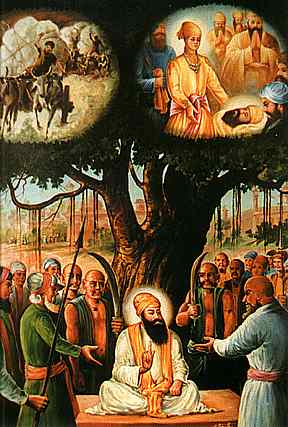
Guru Ji whose original name was Tyal Mal (Master of Detachment) spent his childhood at Amritsar. In his early years he learnt Gurmukhi,Hindi, Sanskrit and Indian religious philosophy from Bhai Gurdas Ji, and archery and horsemanship from Baba Budha Ji while his father Guru Hargobind Ji, Master of Miri and Piri taught him swordsmanship. At the age of 13, a brave young warrior fought alongside his father in the Battle of Kartarpur. When the victorious Sikhs returned home they praised their latest hero and Tyal Mal Ji was renamed Tegh Bahadur Ji (True Ma ster of the Sword). He was married to Mata Gujri Ji at Kartarpur in 1632. When his father nominated his grandson Har Rai Ji as his successor in 1644, Tegh Bahadur Ji moved with his wife to the village of Bakala.
For the next 20 years the Master of Detachment spent most of his time in an underground room absorbed in meditation. Guru Ji also went on missionary tours in Uttar Pradesh, Bihar and Bengal. Before Guru Har Krishan Ji passed to God’s court, he indicated that his successor would be found in Bakala. When the Sikhs arrived in the village they found 22 false Gurus claiming to be Baba Bakala. A wealthy Sikh called Makhan Shah came to Bakala. He bowed to each Guru and gave 2 gold pieces; each Guru was pleased and blessed him. But Makhan Shah was unhappy, then he learnt of a holy man meditating in an underground room. Again Makhan Shah bowed and placed 2 gold pieces. Guru Tegh Bahadur Ji said: “Why have you broken your promise ?, when you prayed to God to save you and your ship from the terrible storm you promised 500 gold pieces to the Guru”. Makhan Shah was overjoyed, he gave the rest of the gold as promised and ran to the roof shouting “The True Guru has been found, O Sikhs come seek his blessing”. The false Gurus all ran away.
After a short time oppre ssion and intolerance reared it’s ugly head. The Moghal Emperor Aurangzeb ordered Hindu temples to be destroyed and that idol worship was to be stopped. He had a temple converted into a Mosque and slaughtered a cow inside it. He also had Hindus sacked from their government jobs and employed Muslims instead. Aurangzeb also ordered Gurdwaras to be destroyed and expelled many missionaries from the main cities. Despite some resistance after many years of persecution people were being forced to take up Islam.
Aurangzeb being clever, decided if he could convert the leaders of the Hindu religion then millions of followers would also convert. He started persecuting and harassing the Hindu Pandits of Kashmir. The Pandits overcome by panic came in a delegation to Anandpur Sahib and requested Guru Tegh Bahadur Ji’s help. At this time Guru Ji’s 9 year old son Gobind Rai Ji told his father that “Who would be better than you to defend the poor Brahmins”. Guru Tegh Bahadur Ji decided to stand up for the right of freedom of worship and told the delegation he was ready to sacrifice his life to protect the Hindus from mass conversion.
Guru Ji nominated Gobind Rai as his successor and left for Delhi with 3 other Sikhs, Bhai Sati Das Ji, Bhai Mati Das Ji and Bhai Dayal Das Ji . Along the way all were arrested and taken to Delhi were all accepted death by torture rather than give up their ideals and convert to Islam. Guru Ji was beheaded on 11 November 1675, Bhai Jetha took Guru Ji’s head to Anandpur Sahib were it was cremated and Bhai Lakhi Shah carried Guru Ji’s body to his house, which he then set on fire to cremate Guru Ji’s body.
Guru Tegh Bahadur Ji had a versatile personality, a warrior, family man with social commitment and a preacher of great understanding and vision. His martyrdom broke the myth of Aurangzeb’s religiosty.
The achievements of Guru Tegh Bahadur are remarkable;
• During the last period in Guru Ji’s life, Guru Ji founded a new town called Anandpur Sahib (City of Bliss) and went on missionary tours to UP and Bengal. Guru Ji also initated welfare projects all over northern Panjab.
• Guru Ji symbolised the triumph of good over evil, Guru Ji’s martyrdom unique in the history of mankind, inspired many Sikhs to lay down their lives for noble causes and moral values.
• Guru Ji was also a versatile poet and embodied a message of freedom, courage and compassion; “Fear not and frighten no“

Friday, November 17, 2006

Kirtan Darbar in memory of Bhai Gian Singh Ji Surjit

"The God-conscious being lives forever, and does not die."

Keertan Darbar in memory of Giani Gian Singh Surjit
Kirtan darbar is on SATURDAY 18th NOVEMBER from 6pm - 10pm at Gurudwara Dasmesh Darbar, East London 97-101 Rosebery Avenue, Manor Park, London E12 6NQ. Ragis jathas that are attending are below:
Bhai Amarjit Singh Ji Gilligham Wale
Bhai Amarjit Singh Ji Nanaksar Wale
Bhai Daya Singh Ji
Bhai Sital Singh Ji Sitara

Wednesday, November 08, 2006

Kirtan Darbar in memory of Giani Gian Singh Ji Surjit


Spending this life fruitfully gurmukh goes to the other world. There in the true court (of lord) he gets his true place.
In memory of Bhai Sahib Bhai Gian Singh Ji Surjit there will be a Kirtan Darbar on Saturday 11th November 2006 from 6:00 p.m to 10:00 p.m at Shri Guru Nanak Darbar Gravesend Kent. Ragi Jathas that will be attending are:
· Guru Nanak Komal Sangeet Acadmey, Gravesend
· Bhai Waryam Singh Ji
· Bhai Sital Singh Sitara
· Bhai Ajit Singh Ji Bilga
· Bhai Sewa Singh Ji Lalli
· Bhai Harbans Singh Ji Suraj
· Bhai Gurmail Singh Ji Manakpuri and Jathedar Tirath Singh

Please attend and remember this great Gurmukh Pyara through Kirtan. The Kirtan darbar is being held by Guru Nanak Komal Sangeet Acadmey Gravesend to support Guru Nanak Mission Neterheen Birdh Ashram GT Road, Sapror Nangal Phagwara ,Punjab, India.

For further information contact the numbers below:
Parvinder Singh – 07817695042
Bhai Sital Singh Sitara – 07877743341
Gurdwara Guru Nanak Darbar Gravesend – 01474 534121
www.littleblindpeople.com

Wednesday, October 25, 2006

Funeral of Bhai Gian Singh Ji Surjit


Vaheguru ji ka khalsa Vaheguru ji Ki fateh
'Spending this life fruitfully gurmukh goes to the other world, There in the true court (of lord) he gets his true place'

Humble benti to all sangat to attend the funeral of Giani Gian Singh Surjit who gave a lot to the panth he taught keertan across the world and done a lot of seva for the sikh panth. Bhai Sahibs funeral will be on Monday 30th October 2006 body will arrive at Guru Nanak Education & Sports Complex, Khalsa Avenue (Trinty Road), Gravesend, Kent DA12 1LU at 10am following onto Medway Crematoruim at 1pm. Back to Guru Nanak Darbar Gurdwara, Clarence Place, Gravesend, Kent. DA12 1LD at 2pm. All details will be avaliable in this weeks main punjabi newspapers. Bhai Sahib Gian Singh Surjit gave the sikh panth a lot of his valuable time, he taught kirtan to hundreds of people our families, us, our children. I am sure for all that time Bhai Sahib spent we can all spare at least one day to pay our final respects to such a diamond of the panth that gave all his life doing seva for the sikh panth.

Vaheguru ji ka khalsa Vaheguru ji ki fateh

Monday, September 25, 2006

Bhai Sahib Bhai Satvinder Singh and Bhai Harvinder Singh


Bhai Sahib Bhai Satvinder Singh and Bhai Harvinder Singh

Bhai Sahib Bhai Satvinder Singh, Bhai Harvinder Singh and Bhai Manjit Singh (Goldy) will be doing Kirtan on Sunday 1st 0ctober 2006 from 6:45 p.m to 8:00 p.m at Shri Guru Nanak Darbar Gravesend Kent. Please attend and enjoy Bhai Sahibs Kirtan.
For further information contact the numbers below:
Parvinder Singh Lalli – 07817695042
Gurdwara Guru Nanak Darbar – 01474 534121